Posts

Literacy, NATO, and Afghanistan

Tens of thousands of previously non-literate Afghans can now read, thanks to the five-year NATO-led $200 million literacy program for the Afghan national security forces. With fewer than 28 percent of adults who can read and write, non-literacy in Afghanistan is exacerbated by decades of war and disruptions in public education. Non-literacy among Afghans of military age was a major hurdle for the NATO coalition in Afghanistan, as recruits couldn't follow basic written instructions or read manuals for new weapons and equipment. NATO set up a course to teach basic reading skills to expand literacy among the new Afghan army and police forces. More than 220,000 members have been trained in basic reading and more than 70,000 have achieved a level of functional literacy. 50,000 more recruits are in the program currently, and the Afghan government plans to continue the program after the end of NATO involvement next year. Fewer than 1 million Afghan children were enrolled in school i...

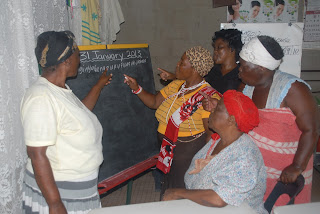
Saakshar Bharat—India’s Adult Literacy Program

Saakshar Bharat is “the world’s largest adult education program” and it aims to make 70 million adults literate by 2017. Only 62.8 percent of India’s population over age 15 can read and write, according to the CIA World Factbook. [1] With a total population in India of more than 1.2 billion people, that translates to more than 446 million Indians who cannot read and write, and does not factor in age-appropriate reading levels or numerical literacy. To combat this, Indian Prime Minister Manmohan Singh launched Saakshar Bharat in 2009 as an initiative of the Indian Department for School Education and Literacy (DSEL). [2] Saakshar Bharat places special emphasis on female literacy in India. Anu Priya, a representative of a village from Villupram in Tamil Nadu said 2,000 villagers were being taught. They had held six exams so far. The next batch of 114 adult students was well prepared for the next exams, she said. "The people have learnt a lot of things. No...

Women in Indonesia receive financial literacy training

According to UNESCO, “Literacy is the ability to identify, understand, interpret, create, communicate and compute, using printed and written materials associated with varying contexts.” Literacy is linked with socio-economic progress and is no longer only about the basic technical skills of reading and writing. Take, for example, women in the fishing village of Tanjung Benoa, Indonesia, who recently participated in financial literacy training to improve their skills as the finance manager in their families. The training included simple but crucial tips on financial literacy in an attempt to combat the economic and social challenges the residents face daily, including a lack of understanding on money management and limited access to information. Standard Chartered Bank and the Women’s Empowerment and Child Protection Ministry organized the training. The bank has conducted training programs and financial discussions for more than 500 female microentrepreneurs throughout ...

Peace is back and so is school – Campaign for Education Normalcy in Mali

As the school year gets underway here in the United States, UNICEF and the Malian Ministry of Education are working to ensure that the same can be said for Malian school children on October 1, the beginning of their school year. Due to political and environmental conflict in the country and region, the Malian Ministry of Education estimates 800,000 children have had their schooling interrupted. Many schools lack basic necessities for the 2013-2014 school year, including benches for the classrooms and notebooks for the students. UNICEF representative in Mali, Francoise Ackermans, said, “An educated child is becoming a citizen of his own country and of the world. This is one of the basic rights of every child. This is in the constitution in Mali – that every single child has the right to free education, to free quality education. We are far from there. We have to commit ourselves to work together on that.” To attend to the education needs of schoolchildren in Mali, UNICEF needs $2...

International Literacy Day 2013- Literacies for the 21st Century

Image
According to UNESCO, “over 84 percent of the world’s adults are now literate.” While this is an encouraging statistic, representing an 8-percentage point increase since 1990, it still leaves more than 774 million adults around the world who cannot read or write. September 8 is International Literacy Day. UNESCO declared the day in 1966 to raise awareness of literacy issues around the world. This year’s theme is “Literacies for the 21st Century,” reflecting the idea that literacy is the cornerstone of peace and development today since literacy is at the heart of basic education for all. An international colloquium on this issue will be held at UNESCO’s Paris Headquarters on Monday, September 9, as part of the celebration for International Literacy Day. Opened by the Director-General, the event will bring together ministers and deputy ministers of education, development and culture from Afghanistan, Benin, the Republic of Chad, India, Namibia, Pakistan, and Senegal, along with repres...

Inequality Still an Issue in South Africa

Image
The Gender Statistics in South Africa study revealed that South African men are overall economically better off than South African women. South African men have higher annual expenditures, lower unemployment rates, and longer life expectancies. “Even in death, the registration of women who have died is much lower compared to the registration of dead men. That happens because there is nothing to inherit from a woman and a lot to inherit from a man,” said statistician-general Pali Hehohla. The inequality between South African men and women is even more apparent in the black population. The extensive inequality gap between the black and white populations is stemmed from the South African apartheid that existed from 1948 to 1991. Black men and women were forced to live in overcrowded townships and had poorly funded schools. Due to poor educations and oppression, black South African women have the lowest employment rate of 30.8% while white men have the highest at 72.6%. Learners ...

World Refugee Day - June 20, 2013

Today is World Refugee Day. UNHCR (the UN Refugee Agency) commemorates the strength and resilience of the more than 45 million people around the world who have been forced to flee their homes due to war, persecution, or natural disaster. Multiple emergencies have forced record numbers of people to flee—yet  the vast majority of media coverage given to the conflicts in Syria, Mali, South Sudan, and Democratic Republic of Congo, rarely focuses on the human cost. In celebration of World Refugee Day, UNCHR has launched a campaign called the “1 family” campaign to remind the world that the victims of war are mothers, fathers, sons, and daughters and that even  1 family torn apart by war is too many. As part of this campaign supporters are encouraged to take a picture of one thing they would take if forced to flee their home. Share a picture and see what items people cherish all over the world on the UNCHR campaign pinterest page. ProLiteracy has supported refugees for man...